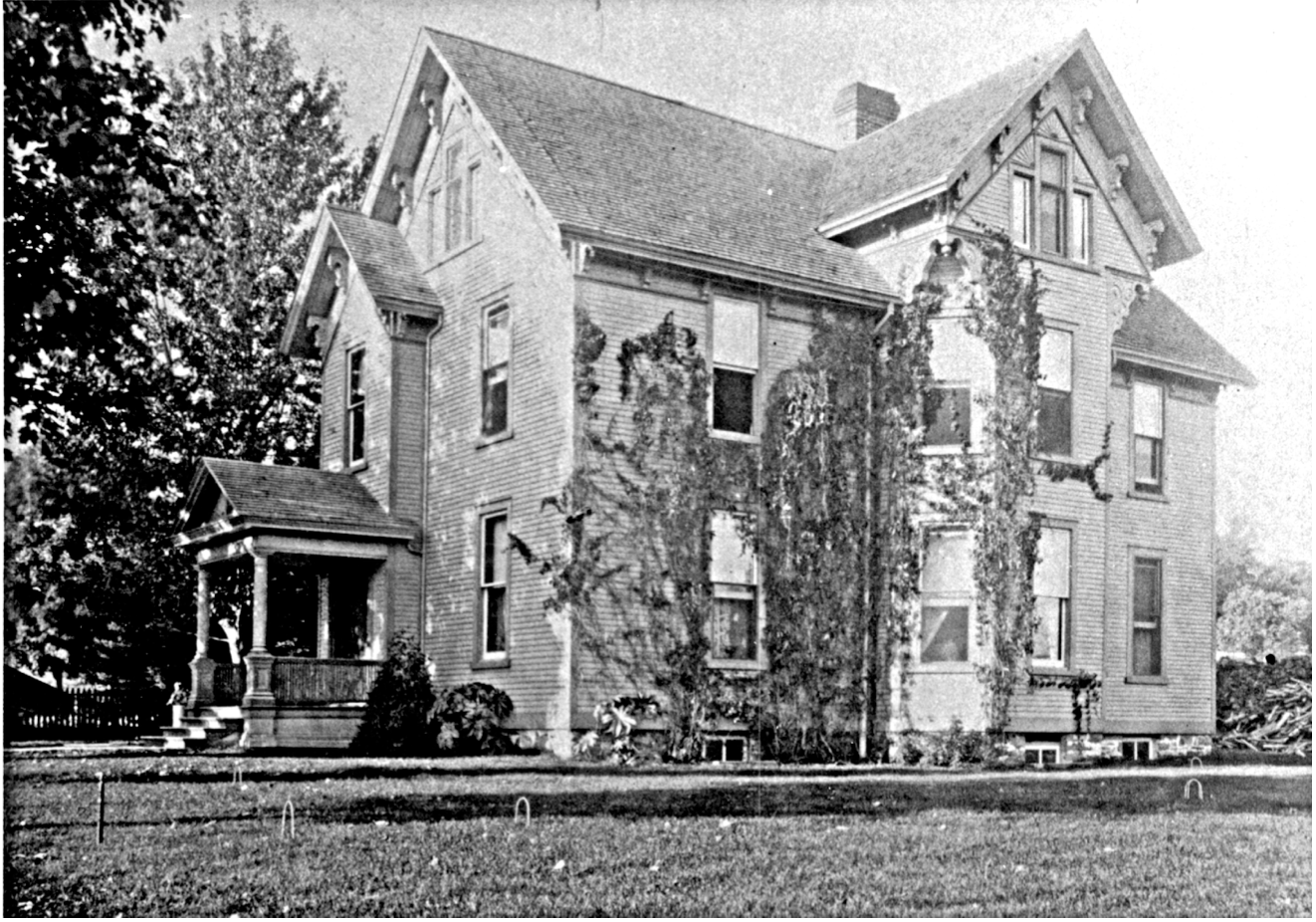
In the late 1880s, William Proudfoot (1851-1925), Muskoka master builder, started work on his own residence, shown in this picture. The large Queen Anne- style house of narrow pink clapboard still sits prominently on a height of land overlooking Huntsville. Its many fine architectural features include double front doors covered by a classical portico. A sun motif is detailed above the portico and on the gables. Under the eaves are elaborate carved brackets and pendants and, on the south side of the house, a handsome bay window rises the full three storeys.
William Proudfoot was born in London Township, London, Ontario. His grandfather, Rev. William Proudfoot, was a renowned Presbyterian theologian, educator and publisher, after whom Proudfoot Hall at the University of Western Ontario is named. He had emigrated to Ontario from Scotland in 1833. Alexander Proudfoot, eldest son of Rev. William Proudfoot, left London Township and took the opportunity to obtain Lots 28 and 29, Concession 13, Stephenson Township, near Allensville, under the 1868 Free Land Grants and Homestead Act of Ontario.
Here, in 1860, he moved with his wife and family of four children – Mary Isabella, William, Hart (for forty years Huntsville’s assessor), and Alexander (Sandy). They established their farm and eventually a large family home was built. As well as farming, the family operated a sawmill on Martin’s Siding Lake and a boarding house next door. Alexander Proudfoot was one of the men who worked on the building of the historic log Madill Church in Stephenson Township in 1873.
Young William left the family homestead in the 1870s and moved into the hamlet of Huntsville. In an early directory of the period he is listed as a “pump and wagon maker.” In 1881 he married Lydia Allison Hunt, eldest daughter of Captain George Hunt, pioneer citizen of Huntsville after whom the town is named.
It seems that William Proudfoot got into the contracting business gradually. He was involved in the construction of Huntsville’s first courthouse, the original Presbyterian Church and manse on Church Street, and Dr. Jacob Wilson Hart’s first hospital on Chaffey Street. His ledgers for the years 1892-1925 survive, as well as an incredible collection of two hundred and fifty architectural drawings, mostly of the Huntsville area which are now archived at the Muskoka Heritage Place. From this tremendous source of material, and from the surviving buildings and artifacts, it is easy to see that William Proudfoot was an incredibly versatile and productive craftsman. Many of Huntsville’s finest public buildings and homes are his work. By 1896 he was signing “Architect” after his name, and he was advertising in architectural magazines.
The first village council of Huntsville, in 1886, included William Proudfoot. He was on the school board, very active in St. Andrew’s Presbyterian Church, and in the Sons of Scotland. In politics he was a Liberal, as was his famous grandfather.
William Proudfoot’s home, “The Pink House,” and all the information pertaining to his wife’s family, the Hunts, and to his own family, the Proudfoots, are his legacy to Huntsville. The house remains a dominant landmark in Huntsville.
 Huntsville and Area Historical Society