Flags flew at half mast. All Huntsville stores and businesses closed on the day of Dr. Jacob Wilson Hart’s funeral in August 1924. No other resident has ever been accorded such an honour.
He was born in 1858 in East Durham, Ontario, first a teacher, then a graduate from Trinity Medical College, Toronto, in 1886. He began the practice of medicine in Huntsville the same year.
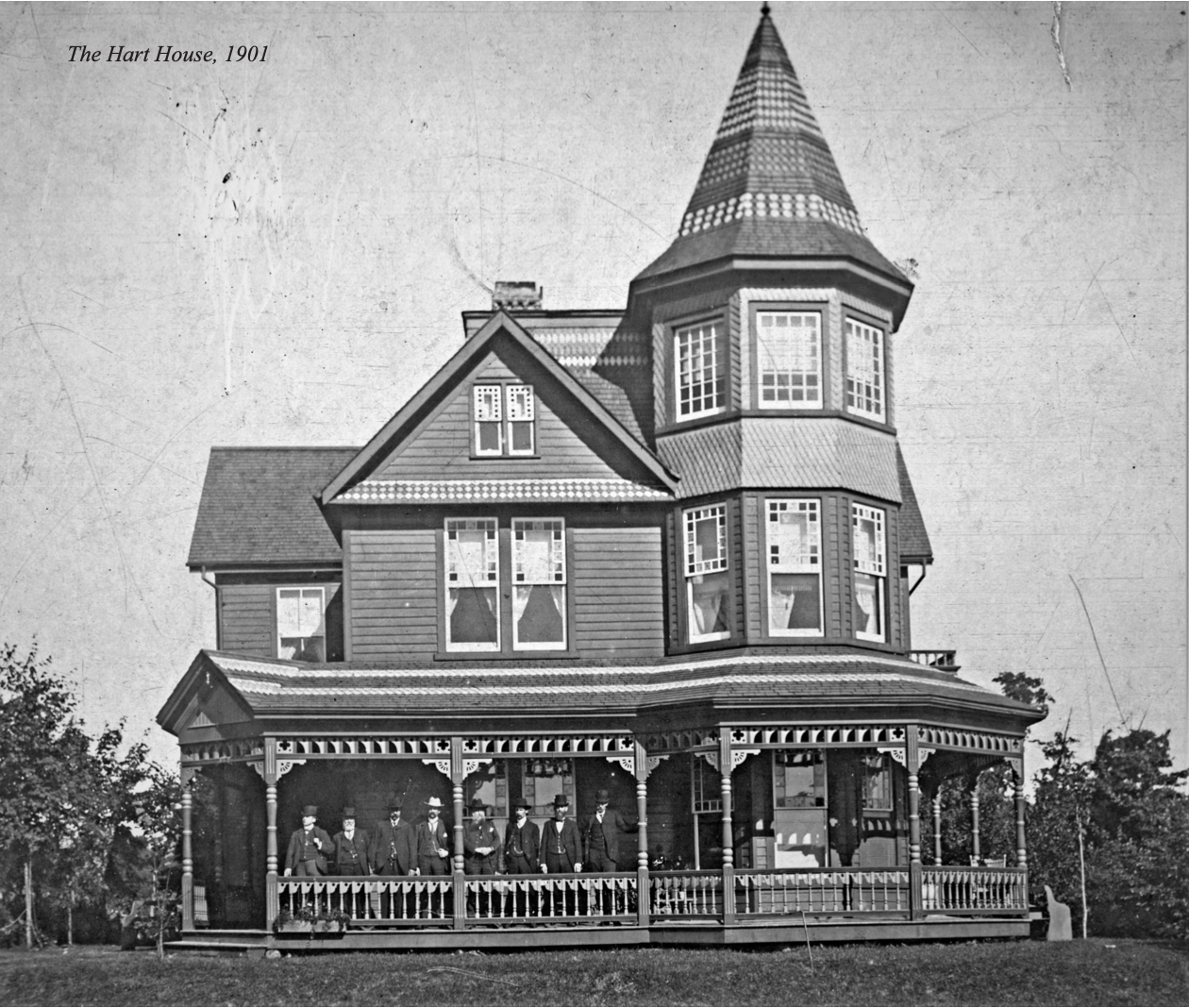
After marrying a local girl, Martha Park Hood, in 1892, he purchased one and one-half acres of land along the west side of the river and proceeded to build his stately shingle-style home (shown in this picture with the 1901 town council on the verandah). Its most dominant feature is a three-storey turret, capped by a bell-shaped hexagonal roof of patterned tile. Verandahs on three sides are decorated by factory-made fancy fretwork which, with the balustrades, enhance the beauty of the house. Spacious lawns surrounded the building, terracing down to the banks of the river. At one time there was a stable and boathouse on the property.
The interior of the house follows the Victorian trend of opening up inner spaces and experimenting with new forms. The sequence of hall, spectacular double front parlour, library and dining room, give a remarkable fluidity to the floor plan. The parlour fireplace is decorated with hand carved cherry wood and the ceiling has a medallion in fern and scallop motif.
The staircase widens as it descends from the landing and curves into the front hall. The woodworking skill and craftsmanship of William Proudfoot, who built the house, are well displayed here. One of the most striking features of this home is the lavish use of stained glass in vivid red, green, gold and blue. Some of the panes are etched with patterns. The stained glass in the transom above the front door proudly displays a large red heart!
The house incorporated the most advanced ideas in the technology of the day to bring the utmost comfort to its inhabitants. In 1894 electricity had not officially come to Huntsville, so Dr. Hart purchased electric power from the newly founded tannery. The water system was well planned. A windmill on the property pumped spring water to a holding tank under the roof for use throughout the house for drinking and cooking. Soft water from the eavestroughs was gathered in a large cistern in the basement for washing.
As an active physician, politician and businessman, Dr. Hart had a strong impact on the community. Foremost among his accomplishments was the establishment of two hospitals in town and an innovative form of health insurance. The first hospital was built in 1886 on Chaffey Street in Huntsville. And in 1901 an addition of thirty-six rooms and offices, constituting a second hospital, was added to the rear of Dr. Hart’s handsome residence on King Street. It could accommodate eighty patients. By 1909 a change in government grants caused Dr. Hart to close the hospital wing. It stood empty until 1941. For twenty years, from 1941-1961 (when it was demolished), Dr. Hart’s only daughter, Marjorie, ran it as a tourist home. Hart House became well known to a new generation of people.
Politics was in the blood of the young physician. During the critical years of the village’s growth, 1891 and 1892, he was elected reeve by acclamation. By 1901 Huntsville had become incorporated as a town, and Dr. Hart was its first mayor. He held this position for three years. In 1905 one of the hottest by- election campaigns in provincial history took place when Dr. Hart, the Liberal candidate, was defeated by Arthur A. Mahaffy of Bracebridge.
The lumber industry interested Dr. Hart. At various times, he was involved with the Muskoka Lumber Syndicate, The Muskoka Wood Manufacturing Company, and also the National Wood Manufacturing Company of South River.
Besides his daughter, who died in 1981, Dr. Hart had a son, Jack, who was killed in action at Vimy, France in 1917. Jacob Hart was a beloved and conscientious family physician. In thirty-eight years of practice he delivered over three thousand babies. His day book indicates that he saw patients three hundred and sixty-five days a year. No five-day week for him!
Today Dr Hart’s legacy remains in the fine Victorian home he built in Huntsville, which sits grandly on a height of land watching over the river, and the swing bridge.
 Huntsville and Area Historical Society