Allen Markle
For eons the river has followed this same route; this jagged seam in the countryside. Patiently carved by ages of grinding ice and then modified and primped by the rivers’ seasons of raging water. It isn’t a big river by any measure, but it drains a substantial area of country to the west of Algonquin Park. From a surging, swirling flood in spring to a mere trickle in dry summers it is generally placid and unremarkable. In the past, each spring and fall it was used by indigenous people as a route into and out of the region. Their summers spent fishing and hunting in an area future generations would call cottage country. Trappers would take furs from along the river and from the myriad tributaries and freshets that emptied into it. Loggers would use it to carry harvested timber from far up-river to mills on the lower lakes.
The native timber, the pine, is mostly gone. Felled almost totally by lumber barons who wanted the cash reward offered for the prime logs. Only isolated trees and small pockets of old growth remain. The upland became clad with maple, beech and cherry, the west and northwest slopes being claimed by eastern red hemlock.
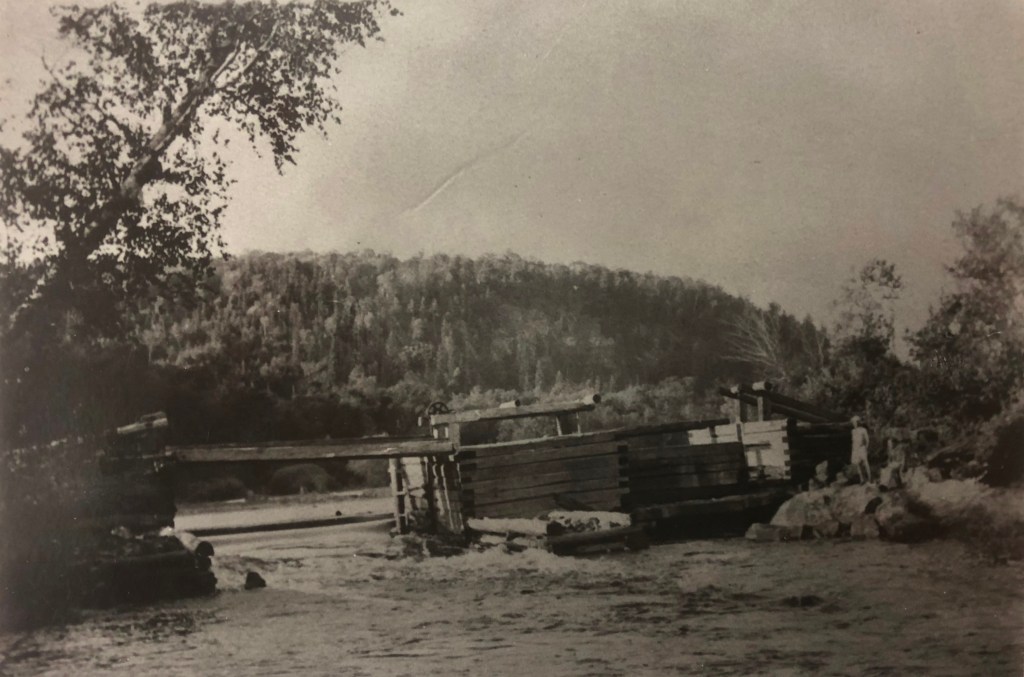
At places along the water-course, steep rocky slopes close in and form natural pinch points that the river men found made convenient sites for ` tumbling dams`. Temporary and artificial barriers to the rivers’ passage. Built of rocks, logs, and lumber, these make-shift dams, over the course of the winter created substantial ice-covered lakes behind them. The felled logs were skidded out to these flooding areas and “decked” near the water or stacked on the ice once cold weather had arrived. The skidways of timber then waited for the warmth of spring.
Rising temperatures and melting snow would swell the volume of water trapped behind the tumbling dams, until the time was right for the ‘drive’ to begin. In succession, beginning with the dam furthest upriver, these dams would be opened and the torrent of water unleashed carried the logs crashing and grinding downstream. Each evening the dam would be closed off so more water could build. The flood of water was like a pulse, beating ‘til the logs reached Lake Vernon. There, crews were waiting to sort and direct the timber to the owner mills.
The surging water caused the logs to gouge the banks of the stream; river bends would be pounded back, great boulders would be crushed or heaved up on the shore. Any sand and gravel spits built up the previous year by each feeder creek and freshet would be obliterated.
Where the river surged over natural rock ledges and falls, the logs thrust forward more than half their length before the waters’ push and gravity drove them over the brink to the river bottom, gouging at the rocks, gravel and bark litter collected beneath the normal cascade. Logs pressing from behind could cause some pieces to be tumbled end over end, or be driven far up on shore. From where they would have to be wrestled back into the river with cant hook, pike pole, brute strength, and nerve.
When the drive was over and the river returned to its summer habit, some of those undercut corners and pounded holes became the cool, dark places where the native ‘brookie’ would lurk.
Waiting for the current to sweep some tasty morsel troutward. People familiar with the river knew where these holes and undercuts where and some people had favorite spots, the locations of which were closely guarded.
I heard a man pose the question to a local, “Do you know where a guy could go to catch a nice speck for lunch?”
“Yeah” was the reply, and the man carefully arranged some tobacco in his pipe, making sure there were no tendrils escaping the bowl. Satisfied, he clamped the stem between his teeth and dug into his pocket for a match. “There’s a few spots like that I know of.” He spoke around the stem of his pipe as he raked the match along the seam of his trousers. Once the flare of sulfur had died away, he lowered the match to the bowl and drew deeply. He exhaled a long luxurious plume of aromatic smoke, waiting and anticipating the question which we both knew was coming.
A short pause and then the man asked…”Well! Where might one of those spots be?” Almost like the information should be gladly offered and not have to be asked for.
Another plume of smoke, not quite concealing the smile which flickered briefly on my grandfather’s lips, followed by an answer most certainly practiced. “Now, if I was to tell you where, then likely those fish wouldn’t be there when I wanted one for lunch”.
Secret spots were secret spots indeed.
Beyond some rocky necks, where the shoulders of the hills drew back and the valley bottom flattened, the river channel wandered from side to side. Seemingly checking its limits and catching its breath. It was in just such a place that Finlayson dam was constructed and an ecosystem was created on a sounder, grander scale than the one created by local beaver.
But before the dam, these flats grew thick with alder, spruce, white birch, tamarack and balsam. The ground beneath the trees was damp and quiet with sphagnum moss. Where hummocks of grasses and sedge found footing, deer and moose would stop and browse. To stand still and quiet and belly deep in sweet fern, bog rosemary, nannyberry and assorted wild asters. The tracks of bear, wolf, and various of the forests’ smaller denizens would be found imprinted in the mud.
Each of these flats was a seasonal ecosystem as are most small lakes and ponds. The difference was that along the river you didn’t find large beaver dams and lodges that you would on smaller creeks and ponds. The thundering river of spring would grind and wash away the past summer’s work. So, the beaver in the lake behind the new concrete barrier would build on the shore. With a brush and mud tunnel extending from the lodge to well beneath the water level and the winter ice.
Everything in the forest is drawn to these places whether natural or artificial, these oases so different from the rocky hills and bush which hems them in. Mornings are greeted with the songs of birds indigenous to the habitat. Bullfrogs and peepers will grump and chirp the day away, all silenced only by a high, hot afternoon sun, the arrival of a great blue heron, or the whistle of pinion feathers braking from speed as a flock of mergansers choose to settle on that exact piece of water. The surface can be glassy calm in the mornings and evenings, often dimpled by bugs, rising up to or touching down on the surface. Occasionally the calm will be punctuated by a large splash and ripple as a cruising fish snatches a morsel. An afternoon breeze can create a surface chop on the water, which will shatter the sun’s rays and broadcast a million shards of light, to dazzle anything or anyone passing there.
In the early years it was rare to find geese on the river, but today pairs of geese will stake a claim along the bank and build a nest. That will invariably draw in the racoons, foxes, ravens, mink and any of a multitude of foragers, seeking to breakfast on goose egg or gosling. The hissing attack of the big male, head lowered and wings extended, is intimidating and the pairs defence of the nest and brood is paramount. They will be ever vigilante. Likely they will lose an egg or two and maybe a gosling later on to a mink, fox, or fisher, but at seasons end they will take two or three offspring with them on the fall migration.
High above, broad-wing hawks drift and cry. As at home soaring as they are navigating thick tree-tops. They ride the thermals, gliding, rising and falling with them. Lower down comes the flash of black ‘headlights’ as an osprey stoops close to the surface, certain there had been the rippled bulls-eye of a rising fish. We always knew the nest was at the end of a narrow bay on the north shore, high in a huge stub, the top of which had been shattered by lightning and blown away in a past storm.
Evenings and darkness brings the yodelling cry of the loon, the call a requirement for any place choosing to be identified as wild or northern. Once, I sat on a stump by a small bay and was startled as a loon bobbed to the surface about 4 meters from me. It rode there surrounded by its attendant ripples, one black eye locked on me. Then, very slowly it turned toward deeper, open water, seemingly propelled by an astern V of wavelets and will power. All the while it held me with that one black eye, until it nodded and slipped beneath the surface.
From the spruce bog comes the hoot of a barred owl and occasionally in the later evening, the booming call of a great horned owl signalling that the night-shift was about to begin. Visual now gives way to audio, for although it could be a dark moonless night, it is not silent. The grinding, scrapping sounds from the far shore discloses the presence of a beaver cutting and dragging saplings to the water. For food and for repairs to the lodges entry which wolves had tried to tear open the previous winter.
The subdued chittering and the dabbling of water announces a family of racoons feeding along the shore, searching for frogs, crayfish, clams, or any other convenient, tasty, treat. There is the barely audible surge and pulse of something in the river and then the hiss of water streaming from a furred body. There comes the suck and plop of hooves struck into and pulled free of the mud. Then the rattling of brush and twigs as the animal, certainly a moose, crosses the river shore, climbs the bank and moves back into the brush and trees again.
Earlier, as the evening was drawing in, a flurry of wings carried a grouse to roost high in a big yellow birch. Later, in the darkness, it could be heard moving about in the branches. All night the bird will browse the buds and the tender leaf tips, gliding to the forest floor to forage tastier stuff once the daylight has returned.
Higher up on the hills, some of the granite shows through the trees. Gray faces that upon inspection, show lightning does strike twice in the same spot and often again. In some places, great, bright splashes show on the rock, where moss and rock-tripe has been blasted away.
Passing here after a storm, the smell of ozone could be fresh and the acrid sharpness of atomized rock might hang in the cooled, damp air indicating a recent strike. I’ve sat across the river from one such pinnacle, with a cold beer in my hand, awaiting a storm running east up the river valley. Felt my skin prickle and heard the air hiss as the bolt struck that granite face 60 meters above me and watched the blue-green light as the bolt flared and died upon the rock.
One time, my uncle and I had come off the river, a storm grumbling from the west, and stored our gear away. Then kicked back and prepared to wait, warm and dry, for the weather to clear and the fishing resume. While he stretched out for a nap, I made a coffee, grabbed my slicker, went and sat on a concrete block near the river and watched the storm come. You could hear its’ hissing approach in the trees and watch the far hills become hazy through the rain. A breeze preceded it up the valley. On this cooler draft came the smell of wet earth, the aroma of late flowering shrubs and the wintergreen perfume of yellow birch that the beavers had felled and gnawed and left the nude sticks to float whitely on the river surface.
At first, only a few rings marked the water where the big drops hit the surface. But they soon began intersecting and then rain began to spatter and tick on the leaves of the tree behind me.
The storm came slowly, its’ sight and sound advancing across the hills and water until it was over and beyond me, my presence of no significance to its purpose of being the bringer of rain.
With my coffee mostly gone and the remainder diluted, the storm front passed but the clatter of rain on my slicker was steady. I went up the bank and inside, shaking the water from the coat before hanging it on the peg behind the door.
“Didn’t you hear that shot?” my uncle asked.
“No. What shot?”
“Could have been a man shooting his dog. It didn’t know enough to get in out of the rain.”
To some people, rain is just rain.
Sometimes after a storm, stretching from the base of a tree, generally coniferous, a ditch will be found blasted in the ground. Remnants of root hanging from its edges as if something had frantically attacked the earth. Soil and humus has been flung away into the surroundings and hangs from the brush and plasters the trunks of other trees. Lightning has struck here and has travelled this way searching for ‘ground’. Down the trunk and along the root, hurling the soil away and occasionally leaving the charred remnant suspended in the trench like a wounded centipede.
The river exits Algonquin’s’ western uplands region, flanked by hills that reach elevations of 480 and 520 meters above sea level, the peaks hulking over the river basin 100 meters below. It was as if God had decided to contain this river and placed the rows of hills as a barrier to keep it right there, so that in low water or raging flood, it couldn’t wander far.
The hills are steep sided and a topographical map shows elevation lines pressed tightly on the river side, making for tough climbing if one chooses to go up there. To me, they also show signs of His hand. For it seems that the piles of earth and rocks used had been dumped like sand from a child’s pail and then a palm pressed down upon each mound. The tops were slightly flattened and when the fingers squeezed, they indented the land. That left the gorges and valleys down which streams from snow melt and summer rains could race to the river and up which we climbed to reach the summits. They couldn’t pay you enough to do that for work, but you pay to do it for enjoyment!
The river always beckoned me, as a child with my father, grandfather and uncles and as a young man. Even when I had to carry all my gear the quarter-mile down the hill to the shore and then, when I could take my wife and children to the dam and ‘up-river’ to the camp.
In the early 50’s, the pond that formed behind the new dam became a hatchery for trout, speckled trout, the fish that all local fishermen craved. Many a muffler or auto body part became detached and abandon on the boulder strewn hill leading down to the river. Dad and I carried the canoe to the river once, finding fresh scrapes on the rocks and were amazed to find a big, new, Chrysler parked there. It showed obvious signs of the trip down the hill. On the river we met a couple of fishermen in a folding sort of row-boat, fishing happily and bailing madly and apparently not at all concerned about the abuse the vehicle had taken. Or that the worst part, the ascent, was still to come.
“The car!” the man said when we inquired. “Hell man, they make them every day. But just you look at the fish we caught!”, and he held up a string of five or six of the prized brookies.
For many years it was a challenge to fish those new waters, having to carefully navigate in and around the dead, flooded tree-tops. None of the timber had been harvested or felled before the basin filled behind the dam. The drowned branches were left reaching up like fingers jutting from the watery surface. It was impossible to go back to camp with even half the lures one started out with. The fish must have curiously approached some of the strange artifacts imbedded in the submerged logs and tree-trunks and you could be sure that, once hooked, the big ones would power into those branches in an effort to break free.
Over the years, the tops rotted and storms and time swept the surface clean, and a two-mile pond was left, long and lean between the hills. Storms from the east or west could churn the surface, but those hills protected the river from any bluster from the north or south. Fifty years on, some decayed stumps of old trees still decorate the lake bottom and shoreline as testament to the forest that was.
At the park line the river is joined by two creeks, McCraney from the north and Mink from the south and at least once a summer my father and I would make pilgrimage to that spot. In later years, it was a long walk for him; to “The Glory Hole” from where the big trout beckoned. When it wasn’t possible for me to go, my father-in-law would stand in and Dad would hang around on Friday evenings when Eric and Jane were coming to visit. The truck has been loaded, groceries packed, fuel and everything for the trip would be ready. The Taylors would arrive, sometimes close to midnight and my father would be very patient. There would be hugs and handshakes all around and maybe even a cup of tea. But eventually, the question, “Are you ready Mr. Taylor? “And Eric would retrieve his ditty bag from the trunk of the 2+2 or Grand Torino.
“Whenever you are Mr. Markle!” and they would be gone.
They would fish and talk the weekend away, with Eric recounting his years in a British navy at war and my father reliving years spent building roads and bridges and mines and microwave towers across Ontario’s’ north. They could both weave tales that entertained us and themselves late into many evenings. Arriving back at our home at midday on the Sunday or Monday and with Jane and Erics’ departure pending, we would hear tales of fish and deer and moose and what the beaver had done on which creek. Tricia and I would have the late afternoon to visit and then after an evening meal, the car packed and farewells completed, her parents would be gone. Until the next time the question was again asked, “Are you ready Mr. Taylor?”
Eric always looked back on the river as a happy place. ‘Heaven” he once said, and although Jane was only there, ‘up-river’, a couple of times, she never really saw it in the same light. It was a river that we reached, only after navigating a really nasty road. What could be so heavenly about that? She always said that if the road to hell was that rough, there would be lots of folks in heaven.
Over the years I travelled, canoed, walked and fished the extent of the Big East, sometimes with fishing buddies and later with my sons. But often I would go alone. From the sand bars where the river dumps into Lake Vernon, I would head upstream through the switch-backs and ox- bows to where #11 hwy. crosses and where in 1954, everyone drove to see the water from Hurricane Hazel close the highway and threaten to sweep the bridge away. My parents drove us there to see for ourselves and talk with all those who had come for the same reason. You could hear the rumble of the torrent in the bridge steel and see the whole structure trembling.
Once past the steep sand banks where Arrowhead Park is now, you had a stretch of flat water, but then it’s back carrying along the shore or towing the canoe when the river is low. Below Rhiness’ rapids, there was always a fish or two so it was worth the trip.
There was a good stretch of canoe water below Dyers’ Memorial and navigable river for a distance further eastward, but eventually it was back to carrying or towing the canoe, casting ahead and letting the lure or fly drift back to a likely spot.
McArthur Chutes was awesome in the spring flood or with high water after a storm and again a good spot for a lurking brookie. Without lots of water though it was simply a series of flat, shelving rocks and a quiet spot to sit in the sun and have lunch. It’s just a short distance from there to the dam at Distress, to Sinclair Bridge and on to McBriens’ Pond. Then you paddled flat water past where the Tonnawanda Creek dumps into the river from the north. I was here once when the blackflies were so intense that even with a coating of fly dope, I was forced to put on my squall-jacket and pull the hood up. The tick and patter of the flies on the fabric was like a steady, hungry rain.
From the East end of McBrien’s the hills neck the river in and there is a series of short flats of canoe water interspersed with rapids. Until you reach Finlayson Dam and the pond where our camp was situated. Upstream or down, I’ve travelled most of the river but never did I do it all at once.
Most of my days on the river were spent from Finlayson Dam eastward into Algonquin Park, enjoying the modified ecosystem the dam created. Where you could hunt and fish and relax and seldom be bothered by the rest of the world. When the temperature falls and snow comes to the uplands, frost will pull a sheet of ice over the broader more sedate sections of water. I’ve walked on ice, two or three inches thick and crystal clear. I could see leaves and debris being carried along the bottom, propelled by the current.
However, in the late ‘90’s, Mike Harris and his ‘Common Sense Revolution’, decided the taxpayers of Ontario would be saved scads of money if Finlayson Dam was no more. The dam was shattered, dragged from where it had been for 50 years and buried in the nearby forest. The valley was returned to the river. I think this is the only dam in Ontario to have suffered such a fate.
There was always something for me to see or learn or suddenly realize when on the pond and river. I never felt a day there was ever wasted. We must have all heard the adage that it’s been a bad day when you have learned nothing and a river can always teach. From the gurgle of water along the hull of a canoe, the lap of waves upon the shoreline or the currents’ chuckle around your shins when you stand among the stones and it sweeps chords of bubbles downstream. If you listen and watch, it will never stop with its’ patient instructions.
The river asks only that you stay as long as you want. Learn as much as you can. And to remember that it’s only in the spring that we rush.
 Huntsville and Area Historical Society