Autobiography – Pt 3 – Louis Cotterchio
In the latter part of 1947, after spending a very busy, but enjoyable, summer at The Highland Inn, I inquired at the headquarters of the Department of Lands and Forests for an employment application. I filled it out, and added a reference from Bob Burns to whom I am grateful to this day for the glowing recommendation he gave to George Phillips, the Superintendent of Algonquin Park. Having not yet gotten word back, I took a job as an assistant carpenter with Mr Cortney from Huntsville who was with the Public Works Dept for the Province of Ontario. He sent me to Smoke Lake to assist in the construction of the enlargement of the hangar which housed the park’s newest aircraft, piloted by Mr Phillips. The Dept of Lands and Forests had just purchased their first Beaver aircraft which was too large to house in the existing hangar, so the building was to be enlarged to accommodate the new plane. The Beaver was an amazing addition to the park as it was the first plane in the world made specifically for short landings and takeoffs, and we all marveled at it. I worked on site, staying with the construction crew at a small cabin near the #60 Highway at the west end of Smoke Lake. I do not remember the owner’s name of that cabin, but it was very comfortable.
I will never forget the surprise that awaited me on February 27th – while working up in the scaffolds, my foreman called out that he had someone who wanted to see me. I went down from the roof to the small office, and there was Mr Phillips. He said he had received my application and the worthy recommendation from Bob Burns who he knew very well (as he used to fly him to fight fires in the Sault Ste. Marie district) and for whom he had the greatest admiration. He said there was an opening for a ranger in Algonquin Park to act as game overseer up near Achray on the hydro transmission line that was being clear cut through the park. I didn’t know where Achray was, but I didn’t care. Here was my chance and I grabbed it! I replied to him that I was prepared to go wherever and whenever he needed me. He said he would be back the next day and for me to have my packsack ready to fly to Pembroke. I did not know where Pembroke was but I said I would be ready. I called home to explain to my family where I was going, and my father said he was very proud of me for taking this chance. The foreman took me home the next day, and I packed up some extra clothes and other things and he drove me back to Smoke Lake that evening.
The next morning, it was clear and cold. Mr Phillips landed on the ice which snowshoed in a large swath up the lake as there was slush over the ice. I had helped to snowshoe this path the evening before with several other employees. At about 10am on February 28th, 1948, I took off from Smoke Lake with Mr Phillips in the Beaver. We flew to Pembroke and I will never forget seeing the town from the air. This was my first of many flights in the Beaver with Mr Phillips, and it was incredible. As we flew over the town, he said “let’s take a loop around that church tower!” and then he did! I can still see the faces of the townspeople looking up at us as we circled the church steeple. He landed on the Ottawa River near the lower end of Church Street, where the Department of Lands & Forests’ head office was at that time. There I met Mr Ed Schuce who was the Fish and Wildlife Supervisor. I spent the day meeting all of the staff there, including one woman I will always be grateful to who, throughout the years, helped me get through a lot of paperwork – her name was Agnes Philibert, my guardian angel, and I will never forget her. From here I was sent via the CNR (Canadian National Railway) to mileage 130 west of Achray to a small log cabin near the west end of Grand Lake. I arrived there with my meager packsack at 2:30am to see an old gentleman who had been notified ahead of my arrival – he seemed grateful that he would finally have a helper. His name was Arthur Kilby (Killry) and was originally from Golden Lake. He was about 65 years of age but only looked to be 50. He directed me to an old square timbered cabin made of White Pine near the shore of the lake amid a grove of 30 white and red pine. The corners of the cabin were flawlessly dovetailed by a perfectionist of that trade, and it was about 22 by 14 feet in size. It contained two small bedrooms at the west end, as well as a small kitchen & living room – I was very glad to have such fine accommodations so deep in the Algonquin wilderness.
I had been assigned by Mr Schuce to patrol the area of the transmission line, which was being cut out from there heading north to the Petawawa River. There were many contractors along this stretch of line clearing and burning the small timber. My two main duties were the protection of the fish and wildlife along the route, especially from trappers, and the estimation of the number of board feet of merchantiles’ sawlogs being processed as the cutting progressed. Mr Schuce reiterated, though, that my most important duty was to apprehend any poachers who were attempting to trap fur-bearing animals or who were carrying guns in the park. This was better aligned to what I was experienced in, as I was a trapper and a hunter on the farm at home and knew what it was all about and what to look for. When it came to estimating the FMB of sawlogs, I did have a lot of previous experience cutting and hauling logs to dumps, but had never participated in the scaling or measuring of them. I quickly learned to count the number of 16 foot sawlogs up to 6” in diameter for many miles along the transmission line as they were being felled and cut. This I did to the best of my knowledge and routinely submitted my tally to the District Office on Agnes St in Pembroke.
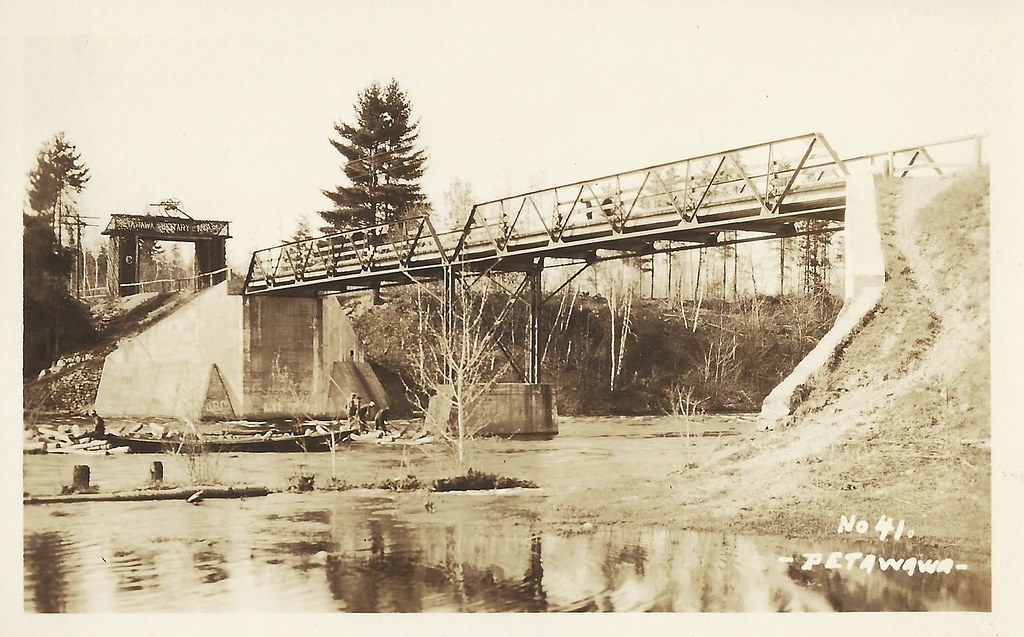
It is interesting to note that there were no vehicle roads in that part of Algonquin Park then. I remember crossing and following many old wagon roads that were fairly open, about six feet wide, and you could follow them by the deep ruts the wagon wheels had made after the many trips they had taken into the northern part of the park. On one occasion, I followed one of these old roads north to the Petawawa where a Bailey Bridge had just been built over the river. I crossed it and noticed that on the north-west side of the river, a bit upstream, there was a small cliff of red rock. It took a good deal of energy for me to hike over, but the expenditure was worth it – the overhang of the cliff was of a pure, bright, red quartzite. I remember thinking how pretty it was and even though it meant that I was late getting back that evening, I truly appreciated the small yet beautiful gift of the park’s landscape that I received in my daily work.
 Huntsville and Area Historical Society