Autobiography – Pt 1 –
Louis Cotterchio
This is the biography of a young man born in 1926. He grew up on a small farm on Lot 14, Concession 13 in Franklin Township and years later, in February of 1948, joined the Department of Lands and Forests to become an Algonquin Park Forest Ranger.
This autobiography will share some of the ways we lived up to the time I was with the Dept of Lands and Forests in Algonquin Park.
We were a family of 8 children who lived in a 2 ½ storey house and actually lived off the land. We cultivated approximately 50 acres of the stoney ground of this area.
The original farm belonged to the Campbells who piled stone fences in straight lines across the fields which can be still seen to this day. We added to the pile of stones every year that the ground was plowed or cultivated. This continued until the middle of 1940 when we, as grown up children, started to progress into better ways of life which would be too detailed to explain in this narrative.
We all grew up during the roaring thirties as a close knit family, a closeness which our descendants today still carry on. We all contributed to the welfare of our family. We were poor, but well fed. As an eight year old, I was assigned the chore of splitting wood but one of the biggest chores was carrying water from our spring well 100 feet from our house – it took a lot of water (and trips) to supply our family of ten, and often more, people. Our enjoyment was very limited prior to 1940. We had no electricity and used coal oil lamps and lanterns – while completing our homework for school, we often required the light from several of these lamps.
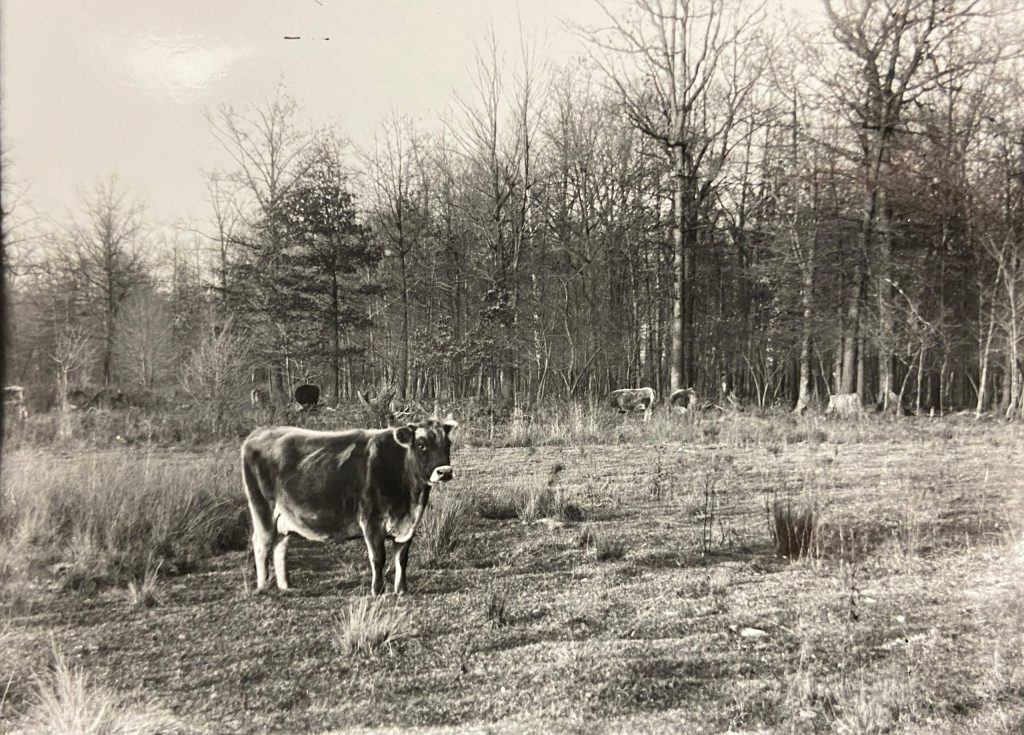
As an eight year old, another one of my chores was to gather our cows two miles from our home after school. They were pastured across the #60 highway, on 200 acres which is now known as Echo Hills or Echo Valley, which was mostly covered by large white pine stumps and young forested area. The cows had to be herded home after school, and I can remember vividly one time after school I was going for the cows in the evening with our English Collie Sport. We had got halfway to where the cows were when I heard a large thrashing sound like splitting wood and there was a large black bear tearing a pine stump apart. I was so frightened, I called the dog to me and ran in the opposite direction to the newly built highway #60 flagging down the first old car that came towards me (driven by Lloyd Hill). He stopped and I got in with my dog, and as I told him about my experience he brought me home. When I got home, my father took pity on me and went for the cows. I thought at that time that a bear would eat you if it ever saw you as that is what was told to us by the many different people who used to stay at our home in the winter logging on our property.
On several occasions, our cows were struck by cars as often it was dark when we crossed the highway #60. This was a great loss to us, especially as it seemed that this was how our favourite cow was killed.
As time went on in late 1940, I gradually became my own master working for my older brother Joseph cutting logs in the bush in the winter as well as working for Gordon Hill who purchased the Burns farm called Terra and the old farm of J Ferguson which Gordon Hill called Hi Low. These were the years when I got to know Bob Burns and Dick Melton who was employed by the Forestry Branch (as it was called from 1930 into mid 1940) in Sault Ste Marie. He would trap all winter and acted as deputy Fire Ranger all summer. He was ultimately the person I attribute to getting me to join the Department of Lands and Forests.

 Huntsville and Area Historical Society
Leave a comment